From our noon update on Sunday –
60 degrees 50 minutes South, I didn’t catch the West, 16 nautical miles per hour headed south. We are 308 nautical miles from Ushuaia and 235 nautical miles to Palmer Station. No icebergs will be seen until early tomorrow based upon the ice maps and ice forecast. Currently the temperature is 6 degrees Celsius with a northwest wind at 30 knots. Sunset 10:54pm. Temperature tomorrow morning and through the day will be around freezing with sunrise at 3:52am. We are experiencing 2 1/2 meter swells. Again he warns one hand for the ship, one for your drink. Scenic cruising starts at 6:15am tomorrow.
About this scenic cruising.
So, today I sat through three talks, two by the expedition team and one by the captain. All were repeated in the afternoon as well. The first lecture was to a mostly full house; the second was to a full house, and the third we were bursting at the seams. It seemed as if a lot of people were frustrated when they realized that in order to have a seat at the 11am talk you need to show up at the 9am talk or you have to be patient – and expect maybe you’re going to be turned away to return in the afternoon.
Pro tip – if you stand in the aisles or sit in the aisles or on the stairs they will make you leave and the whole theater will wait until everyone situated as such has left.
The Boss reports that the questions asked in the afternoon were… less well thought out than the questions asked in the morning.
Adrian the geologist mainly spoke about the geology in the glaciers – the patterns and layers that develop as the glaciers and ice moves and flows, because it does flow.
Antarctica is basically covered by a system of ice streams as shown above with darker colors indicating faster flow of ice and lighter colors indicating nearly-still ice. By faster flow we’re not necessarily talking fast; we’re talking three feet a day, or one and a half Oosterdams per year.
He said he sees these patterns everywhere.

But here is what it looks like on the ice:
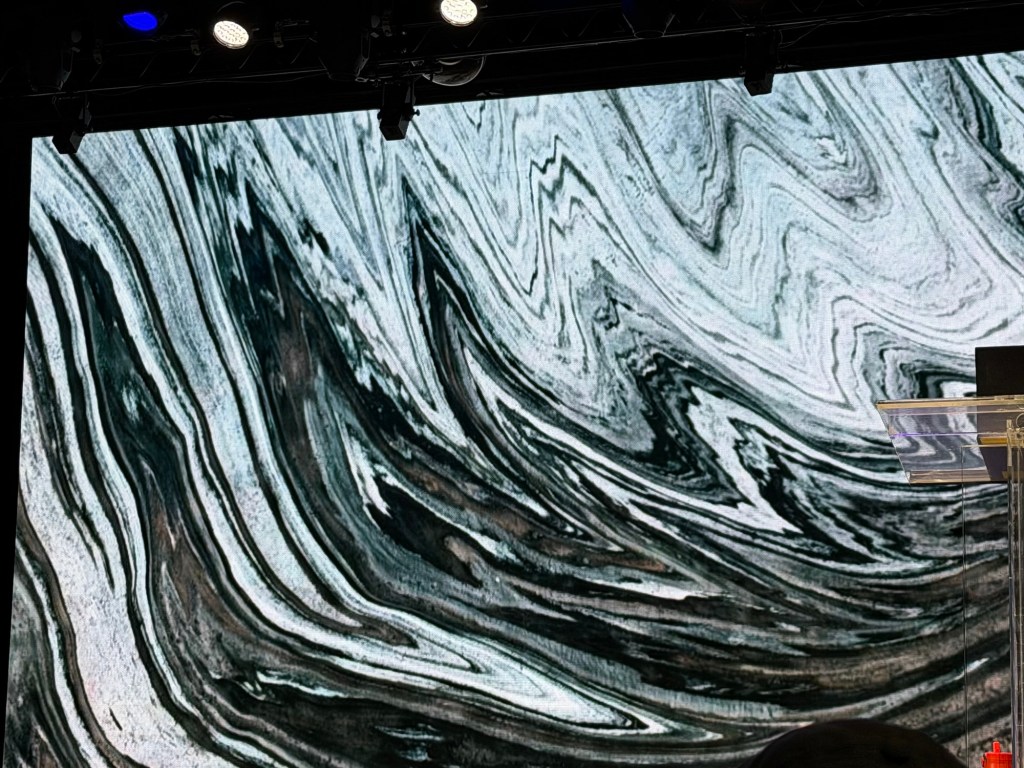
For scale – it’s about ten miles across and it’s taken at an angle, most likely from an aircraft flying into a valley, where you would notice it.
The second talk focused on a bit more depth as Ed is actually a person who studies the ice instead of being ice-adjacent due to time studying geology next to or hidden by the ice. And Ed is a great speaker as well (so is Adrian).
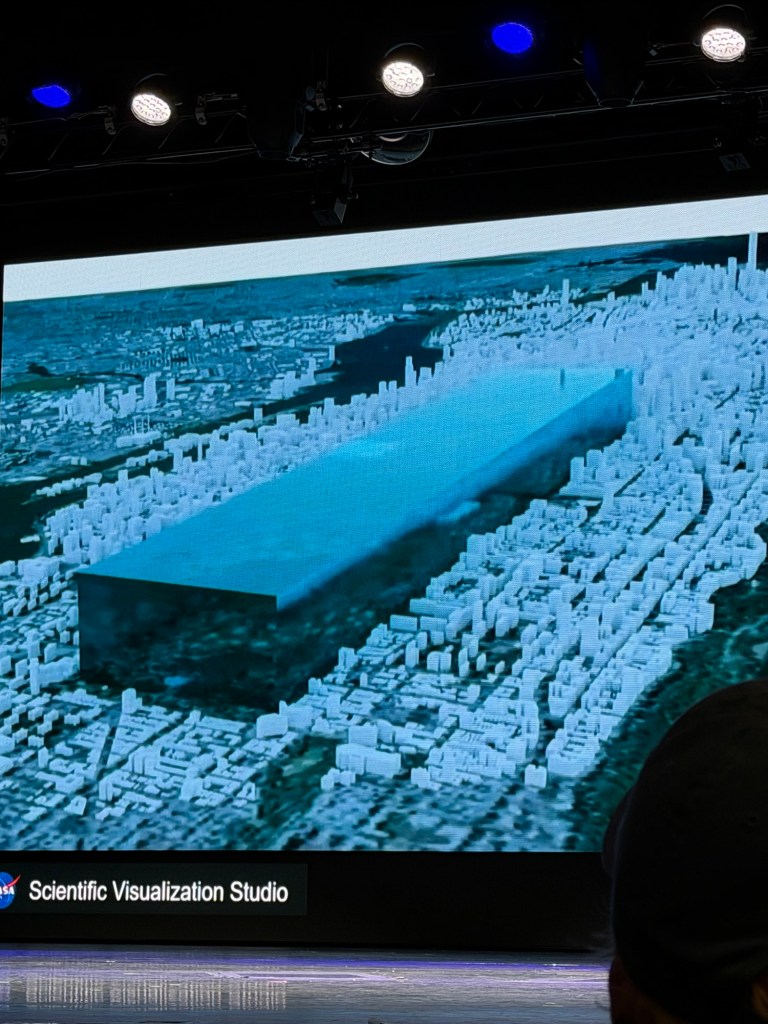
Antarctica has 24.4 million gigatonnes of ice. As you can see above, a gigatonne is a billion metric tons. As you can see below, the size of a gigatonne is roughly a 700 foot tall building sitting on Central Park in New York City.
He also spoke a bit about the creation of icebergs and what happens over an ice sheet’s lifetime – the water flowing under the ice, fresh and salt water moving underneath the ice where the ice breaks off, and so forth. He spoke a bit about the A23a iceberg which is 918 feet tall with only a small portion above ground; A23a also is, or was, the size of Rhode Island and I believe floating somewhere near South Georgia Island now.
But both Adrian and Ed were not the stars of the show. The star was Captain Kevin. In the Antarctic cruise community, at least online on social media and in various forums, Captain Kevin is a hero, in part because he explains in detail what he’s doing but also because he has nervous travelers convinced he has their safety in mind. And he’s funny too.
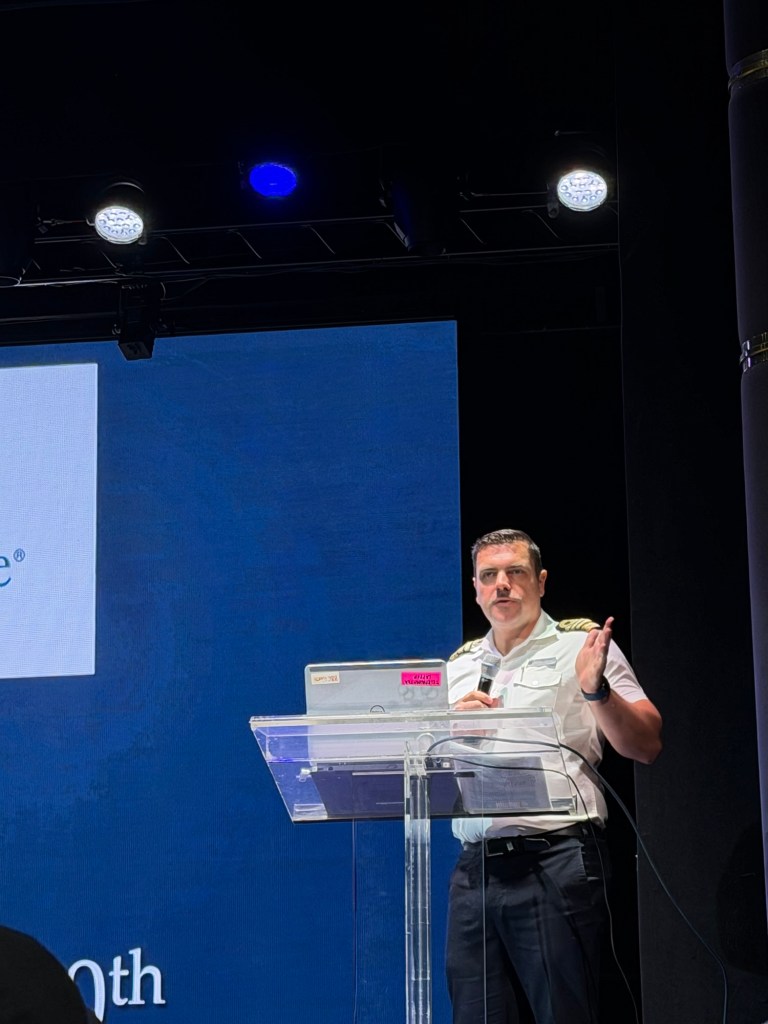
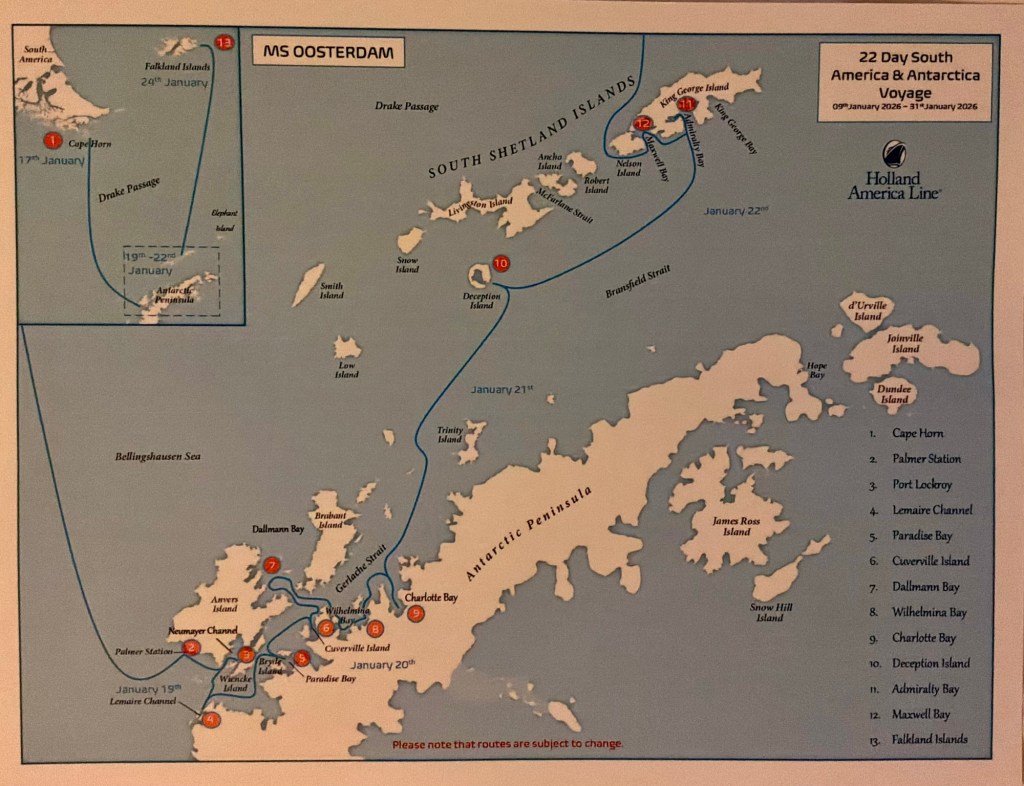
On Sunday Kevin gave us the details behind his planning for the first two days of the voyage. The goal was to visit Palmer Station early Monday morning, like 6am, then visit Port Lockroy and drop off postcards to be mailed, and take an afternoon cruise through Lemaire Channel. Eventually we would overnight in Paradise Bay.
For Tuesday we would visit Cuyerville Island, Dallmann Bay, Gerlache Strait, and Wilhelmina Bay.
Much of this didn’t actually happen, but stay tuned. I didn’t take any more photos on Sunday.
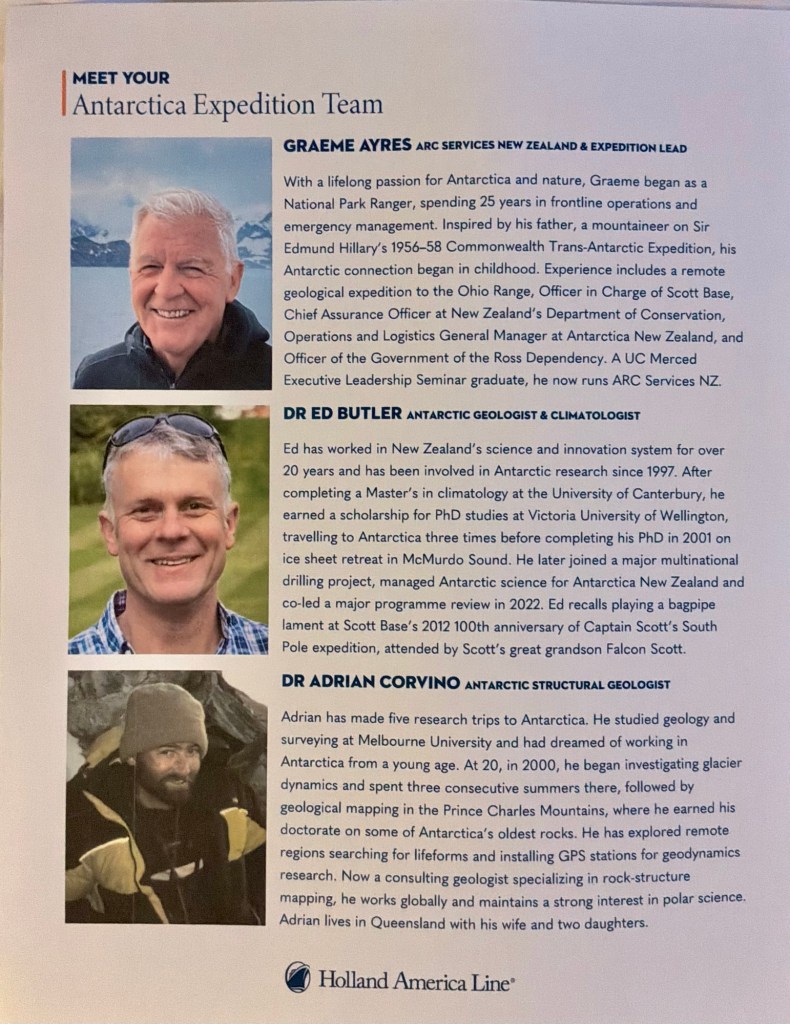
This is the expedition team. Tomorrow they’re presenting on “Life in the Deep Freeze.” As the times line up with a couple of the scenic cruising sites I’m not certain when we will make them. The expedition team is mostly into physical sciences – not so much life – but they’ve done a good job with life sciences and ecology on Antarctica as well. Adrian in particular is highly naturalist-adjacent. I believe he’s married to a PhD biologist.
Anyway. Sunday night was a decent dressy night interspersed with football playoff games. This weekend they’ve been playing the playoffs in Billboard whereas last weekend everybody was left to fend for themselves. There was also a tango dance show tonight, jazz band, and of course the Rolling Stone band. It is / was a lively night on ship.
Weather continues to be gray and gloomy with temperatures falling more and more, and frankly the forecast is not looking promising for New Zealand. I believe the December cruise had two beautifully sunny days out of three; they’re telling us not to bank on that right away. But they’re telling us there are currently reports of lots of penguins in the places suggested so far.
This is actually one of the things the current expedition team is good for – they have a lot of contacts who are out on the ice and have access to current information in conjunction with the bridge.
At least the ship is relatively steady. We should sleep well.
 In Retrospect